Carbon fiber or aluminum: which is better for tubes, frames and arms?
Carbon fiber wins when weight matters. A carbon fiber laminate weighs about 1.6 g/cm³ against 2.7 g/cm³ for aluminum[1], so the same part is roughly 40% lighter. Stiffness depends on the layup: woven carbon is about 20% less stiff than aluminum, while unidirectional carbon is about 1.8 times as stiff along the fiber[2][3].
How do the numbers compare?
| Property | Aluminum | Woven carbon (T300, 3K) | Unidirectional carbon (T300) | Unidirectional carbon (T700) |
|---|---|---|---|---|
| Density (g/cm³) | 2.7[1] | about 1.6[1] | about 1.6[1] | about 1.6[1] |
| Tensile modulus (GPa) | 68.9[1] | 55[2] | 120[3] | 125[4] |
| Tensile strength (MPa) | see alloy sheet | 650[2] | 1,900[3] | 2,300[4] |
| Specific stiffness (modulus ÷ density) | 25.5 | 34 | 75 | 78 |
Carbon values are laminate test results (ASTM D3039) from the technical data sheets of the prepregs we use, not fiber values[2][3][4]. Fiber strength is far higher, but a part is a laminate, so compare laminates.
Specific stiffness (modulus ÷ density)
Higher means stiffer for the same weight. Carbon density taken as 1.6 g/cm³.
What does that mean for a tube?
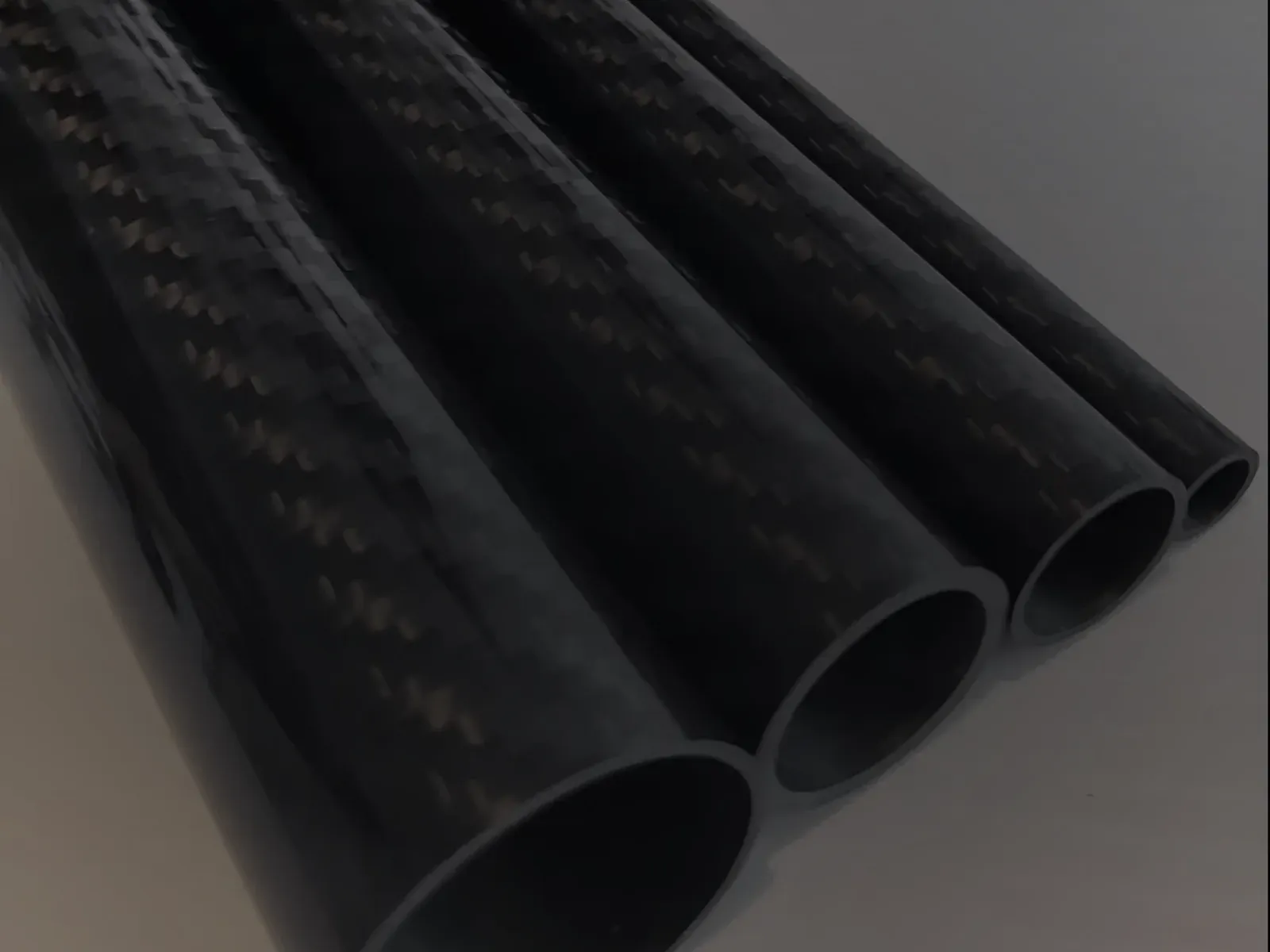
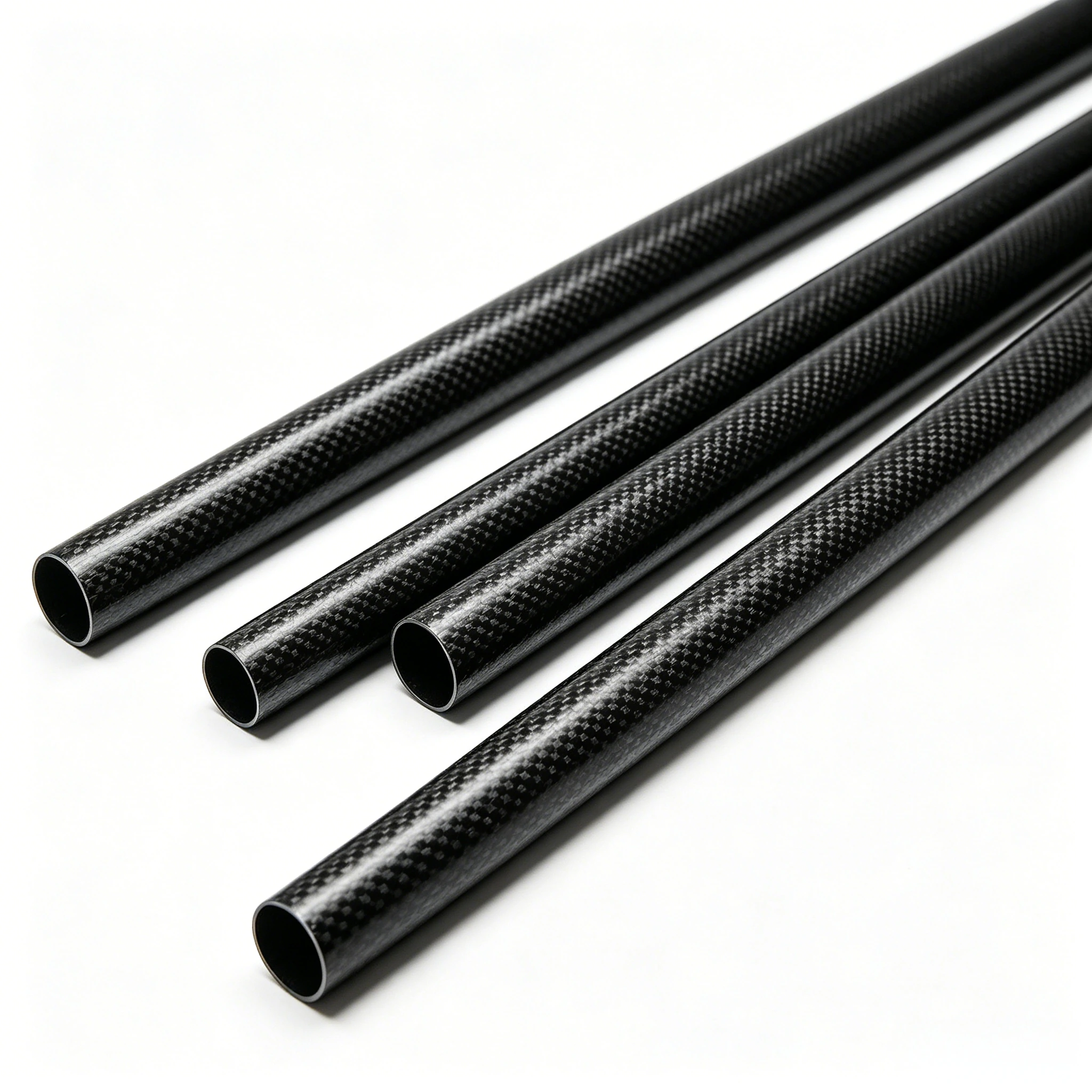
A roll-wrapped tube is usually mostly unidirectional plies with a woven outer ply for looks and crush resistance. That puts most of the fiber along the tube, where bending loads act, so a carbon tube can be both lighter and stiffer than an aluminum tube of the same size. An all-woven tube or plate is lighter but not stiffer.
Where does aluminum still win?
- It bends before it breaks. Aluminum yields and dents. Carbon stays elastic until it fails, without warning. Design carbon parts with a margin and avoid sharp notches.
- Point loads and clamping. Thin carbon walls can crush under a clamp or bolt. Use inserts, sleeves or a thicker wall at fixing points.
- Cost. Aluminum extrusions are cheaper per part. Carbon pays off when weight, stiffness, fatigue or corrosion resistance earn it back.
- Heat. Aluminum keeps its strength at temperatures where an epoxy laminate softens. See how hot carbon fiber parts can get.
- Contact with metal. Carbon touching bare aluminum in wet conditions causes galvanic corrosion of the aluminum. See how to join carbon fiber to metal.
Which carbon option should I ask for?
| Your priority | Ask for |
|---|---|
| Lowest weight, visible finish | 3K woven tube or sheet, glossy or matte |
| Highest bending stiffness | Roll-wrapped tube with unidirectional plies, or a pultruded tube or rod |
| Stiffness at the lowest price | Pultruded tube, rod or strip |
| Flat parts cut to shape | Carbon sheet, CNC-cut from your drawing |
Send the aluminum part’s size, the load and your target weight through the quote form. Standard sizes are on the carbon fiber tube and carbon fiber sheet pages.
Sources
- DragonPlate, “Carbon Fiber vs Aluminum”: aluminum 2.7 g/cm³ and 68.9 GPa, carbon fiber composite about 1.6 g/cm³; aluminum expands about six times as much as carbon fiber
- Technical data sheet, woven T300 prepreg T200R4024T: laminate 0° tensile strength 650 MPa, modulus 55 GPa (ASTM D3039)
- Technical data sheet, unidirectional T300 prepreg C200R2824T: laminate 0° tensile strength 1,900 MPa, modulus 120 GPa (ASTM D3039)
- Technical data sheet, unidirectional T700 prepreg C200Z3624S: laminate 0° tensile strength 2,300 MPa, modulus 125 GPa (ASTM D3039)