
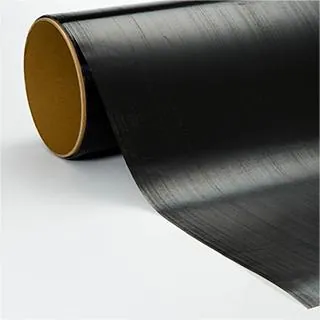
How hot can carbon fiber parts get before they lose strength?
The resin sets the limit, not the carbon fiber. Our epoxy prepreg systems have a glass transition temperature (Tg) between 100 and 130 °C[1]. Near Tg the resin softens and the part loses stiffness, so keep the service temperature well below it. For parts that see several hundred degrees, use high-temperature glass or silica cloth instead[2][3].
What is Tg, and why does it matter?
The glass transition temperature is where a cured resin changes from hard and glassy to soft and rubbery. Well below Tg a carbon laminate stays close to its datasheet stiffness, although modulus falls gradually as temperature rises; use test data at your service temperature where it matters. As it approaches Tg, stiffness and compressive strength drop, parts creep under load and bonded joints weaken. Easy Composites makes the same point in its tube tests: carbon fiber tubes deteriorate above about 120 °C because of the resin[4].
How do different materials compare?
| Material | Temperature figure | Source |
|---|---|---|
| Epoxy prepreg SYE15601 (toughened) | Tg 100 ± 5 °C | datasheet[1] |
| 600 g twill prepreg | Tg 100 °C | datasheet[1] |
| Epoxy prepreg SYZ1021R (flame retardant) | Tg 114 ± 5 °C | datasheet[1] |
| Epoxy prepreg SYE15001 | Tg 130 ± 5 °C | datasheet[1] |
| E-glass fiberglass cloth EW140-100 | does not burn; up to 540 °C | product page[3] |
| High-silica cloth 320 g (≥ 96% SiO₂) | 900 °C long-term; 1,450 °C for 10 min; softening point 1,700 °C | product page[2] |
Temperature figures (°C)
How do I keep a carbon part safe from heat?
- Know the real part temperature. A black part in direct sun, a part next to a motor or a part in a closed housing runs much hotter than the air. Measure it.
- Choose the higher-Tg resin. If parts get warm, ask for the 130 °C system rather than a 100 °C one[1].
- Keep a margin below Tg, especially for parts under constant load.
- Shield hot spots. A layer of high-temperature glass or silica cloth between the heat source and the carbon part protects it.
- Check adhesives too. A bonded joint can soften before the laminate does.
What about fire?
Standard epoxy burns. If your part must meet a flame rating, choose the SYZ1021R halogen-free flame-retardant prepreg, whose laminates meet UL94 V-0[1]. For fire blankets, welding curtains and heat shields, use fiberglass or high-temperature silica cloth rather than carbon.
Send your part, its working temperature and any flame rating through the quote form. Cure cycles are covered in how to cure carbon fiber prepreg.
Sources
- Prepreg technical data sheets: SYE15001 Tg 130 ± 5 °C; SYE15601 Tg 100 ± 5 °C; SYZ1021R Tg 114 ± 5 °C, halogen-free flame retardant, UL94 V-0; 600 g twill prepreg Tg 100 °C (available on request)
- High temperature silica cloth 320 g: more than 96% SiO₂, softening point 1,700 °C, long-term service 900 °C, 10 minutes at 1,450 °C
- Fiberglass cloth EW140-100: plain-woven E-glass, will not burn, for temperatures up to 540 °C (1,000 °F)
- Easy Composites, “Carbon fibre tubes explained”: carbon fibre tubes deteriorate above about 120 °C