
How do I read a carbon fiber quality certificate, and which numbers should I check?
A carbon fiber quality certificate lists, for one production lot, each test, the test method, the allowed range and the measured result. Check five lines: linear density, density, tensile strength (and its CV), tensile modulus and sizing content. If every result sits inside its range, the lot meets the grade it is sold as.
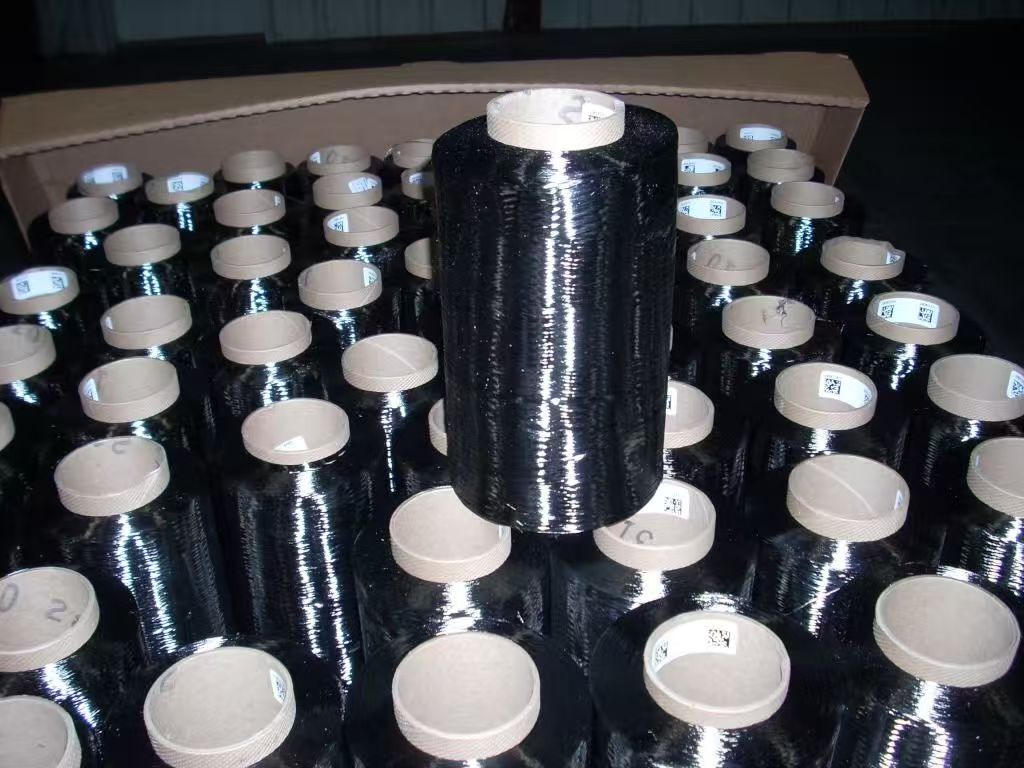
The numbers above come from a real certificate for one lot of 3K carbon fiber yarn, grade SYT45-3K, in our files[1]. We use it below as the worked example.
What is on the certificate?
| Test | Method | Allowed range | Measured |
|---|---|---|---|
| Appearance | GB/T 26752-2020 | black, even, no fuzz balls | pass |
| Linear density (g/km) | GB/T 3362-2017, annex B | 198 ± 6 | 200 |
| Density (g/cm³) | GB/T 30019-2013, method C | 1.80 ± 0.02 | 1.81 |
| Tensile strength (MPa) | GB/T 3362-2017 | ≥ 4,000 | 4,576 |
| Tensile strength CV (%) | GB/T 1446-2005 | ≤ 6 | 3 |
| Tensile modulus (GPa) | GB/T 3362-2017 | 220–260 | 237 |
| Elongation at break (%) | GB/T 3362-2017 | ≥ 1.5 | 1.9 |
| Sizing content (%) | GB/T 29761-2022 | 0.40–0.79 | 0.73 |
Tests were run at 23 ± 2 °C and 50 ± 10% relative humidity[1].
Which five lines matter most?
- Linear density tells you the tow size is right. 3K yarn weighs about 198 g/km, 12K about 800 g/km and 24K about 1,600 g/km[2]. A low value means less fiber in every strand, so a thinner, weaker laminate.
- Density confirms the fiber type. PAN-based carbon fiber is around 1.80 g/cm³[3].
- Tensile strength is the grade’s headline number. It must be at or above the minimum.
- Strength CV (coefficient of variation) shows how even the lot is. A low CV means few weak spots.
- Sizing content is the thin coating that bonds fiber to resin. The type must match your resin (epoxy here) and the amount must sit inside the range, or wet-out and bonding suffer.
Measured result vs minimum required
Bars are scaled to the measured value of each property.
Datasheet or certificate: what is the difference?
A technical data sheet (TDS) gives typical values for a product type. For example, our T300-grade 400 g/m² unidirectional fabric lists a 12K fiber with 4,500 MPa tensile strength and 230 GPa modulus[4]. A certificate gives the measured values for the lot you actually receive. Use the TDS to choose a material and the certificate to accept a delivery.
What else should I check?
- Units and methods. MPa and GPa, and the standard used. Results from different methods are not directly comparable.
- Fiber vs laminate values. Fiber strength (thousands of MPa) is far higher than the strength of a finished laminate. Compare like with like.
- Date and signature. A certificate should be dated and approved.
What to ask for with your order
- The TDS of the product, before you order.
- A lot certificate with every delivery of yarn, fabric or prepreg.
- For tubes, sheets and parts: the material used and its certificate, plus dimensions checked against your drawing.
Ask for documents through the quote form, and see our certificates on the quality page.
Sources
- Carbon fiber yarn quality certificate, grade SYT45-3K, lot T10 202437-1, dated 2024-10-29 (copy available on request)
- Carbon fiber roving: 3K 198 g/km, 12K 800 g/km, 24K 1,600 g/km
- Carbon fiber chopped strand: PAN-based, density 1.80 g/cm³
- Technical data sheet, T300 unidirectional fabric CR12U-400II: 400 g/m², SYT45S-12K, 4,500 MPa, 230 GPa (available on request)