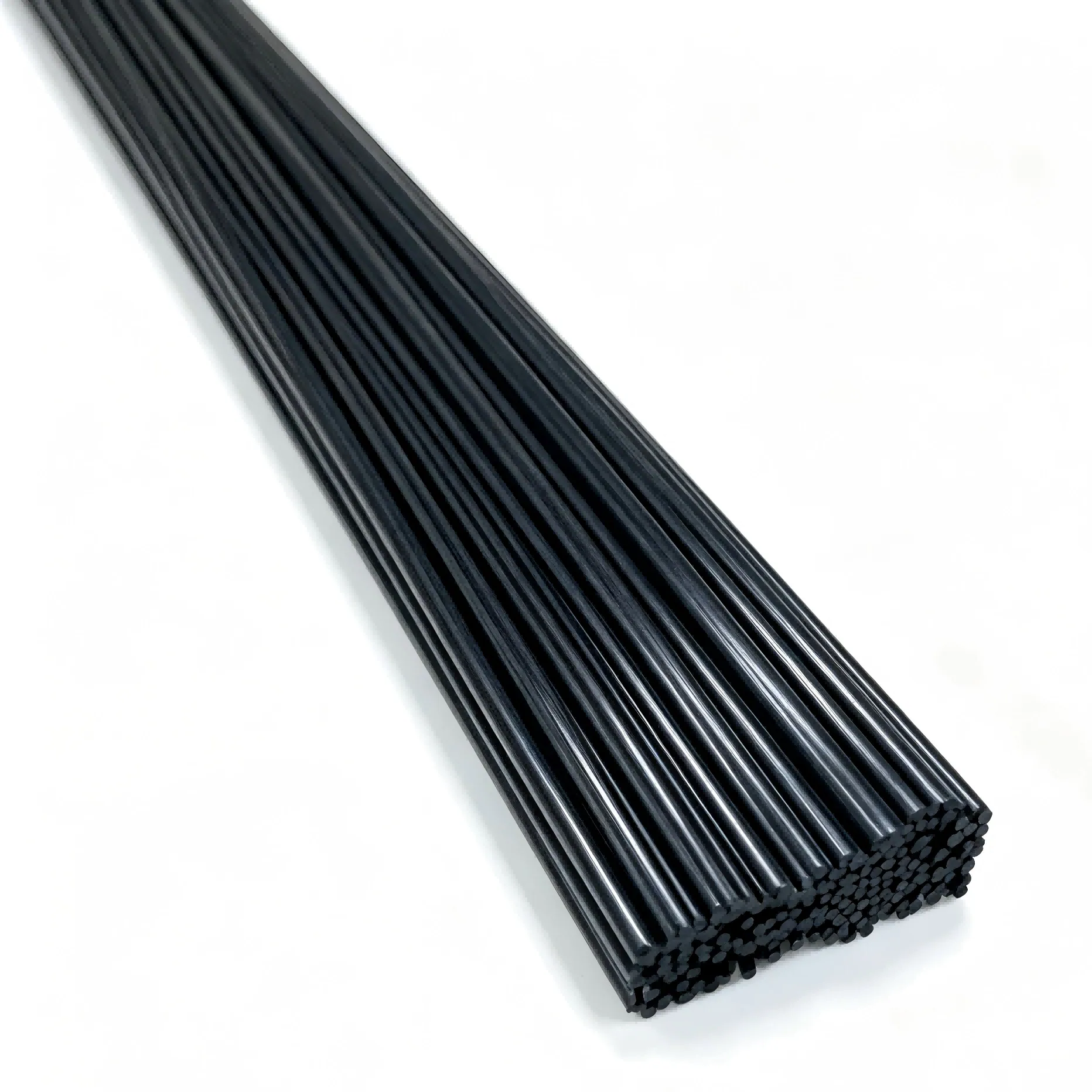
How are pultruded carbon fiber rods, strips and tubes made?
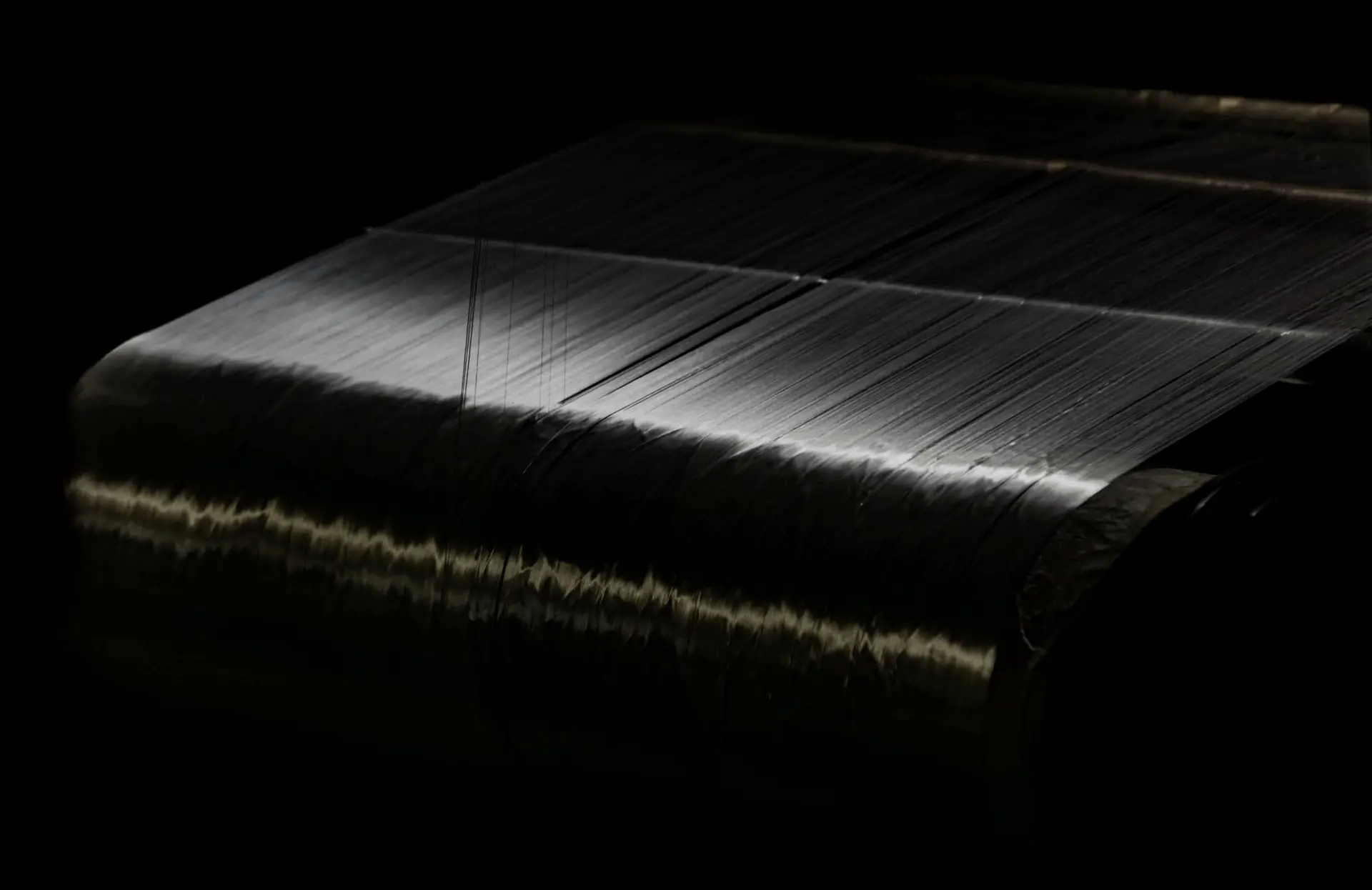
In pultrusion, continuous carbon fiber tow is pulled through a resin bath and then through a heated steel die. The die shapes the profile and cures the resin in one continuous pass. A puller draws the cured profile out at a steady speed and a saw cuts it to length. Because the process never stops and every fiber runs along the profile, pultruded rods, strips and tubes come out straight, stiff and consistent[1]. Our pultruded profiles are made at our own factory in Dongguan[2].
The pultrusion line, step by step
| Step | Equipment | What happens |
|---|---|---|
| 1. Feed | creel | many spools of carbon fiber tow feed in side by side |
| 2. Wet out | resin bath | each strand is soaked in epoxy resin |
| 3. Shape | preformer | guides bring the wet fibers into the rough shape of the profile |
| 4. Cure | heated steel die | the die sets the exact size and the heat cures the resin |
| 5. Pull | puller | grippers draw the profile at a constant speed |
| 6. Cut | saw | profiles are cut to length, typically 1000 mm |
| 7. Check | gauges | diameter or width and thickness, straightness and surface |
Why does pultrusion give straight, consistent profiles?
- The die sets every dimension. Each meter passes through the same steel cavity, so size stays the same along the whole run.
- Fibers are pulled tight. Fibers are under tension while they cure, so the profile comes out straight with no waviness.
- All fibers point one way. That gives the highest stiffness along the length for the weight[1].
What is pultrusion not good at?
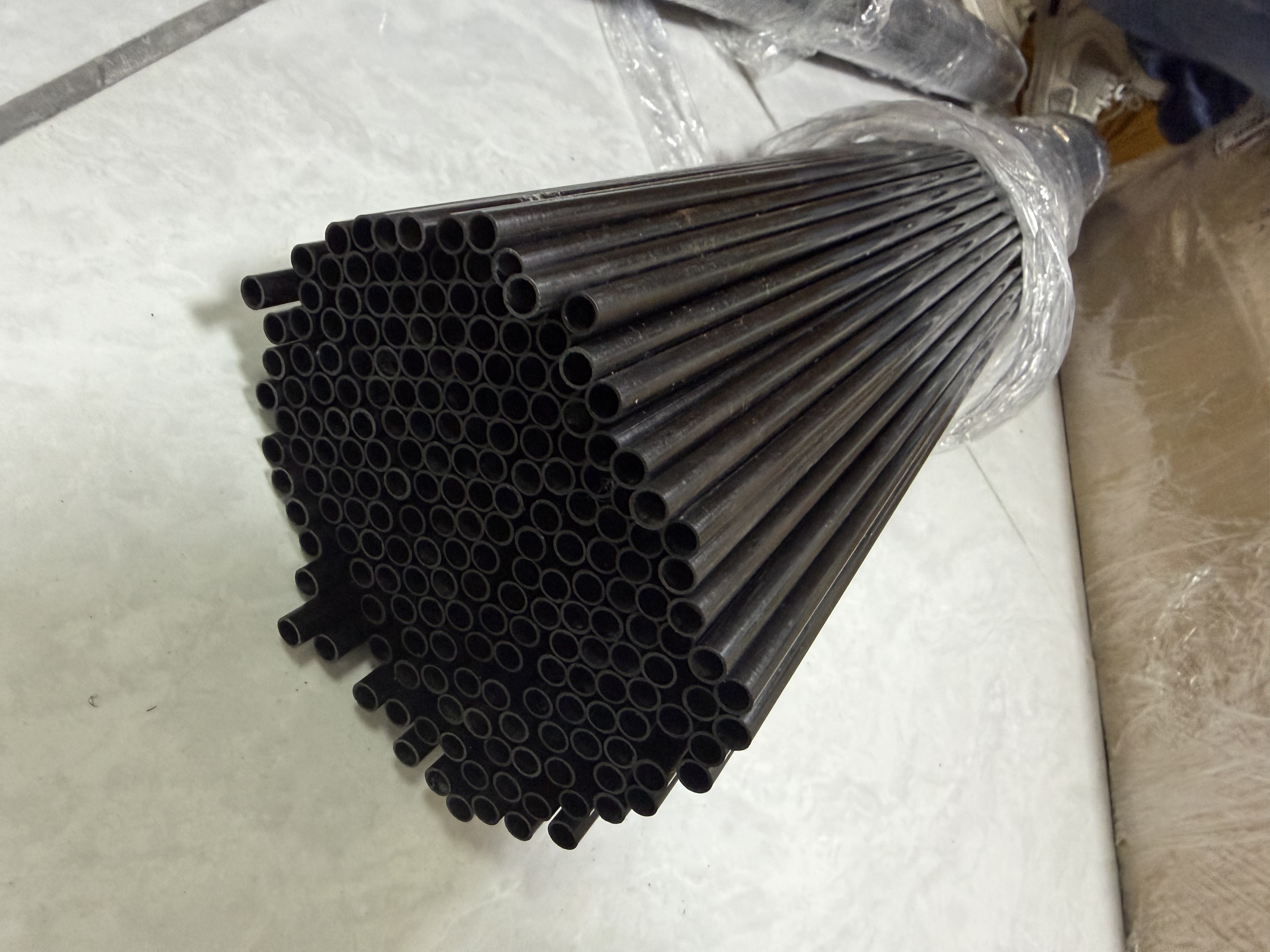
Fibers along the length give little strength across the profile. A pultruded tube can split if it is crushed, clamped hard or twisted, and a strip can split along its length if it is drilled near the edge. For those loads choose a roll-wrapped tube, or ask about adding cross plies. Pultrusion also needs one die per profile, so a new shape has a tooling cost.
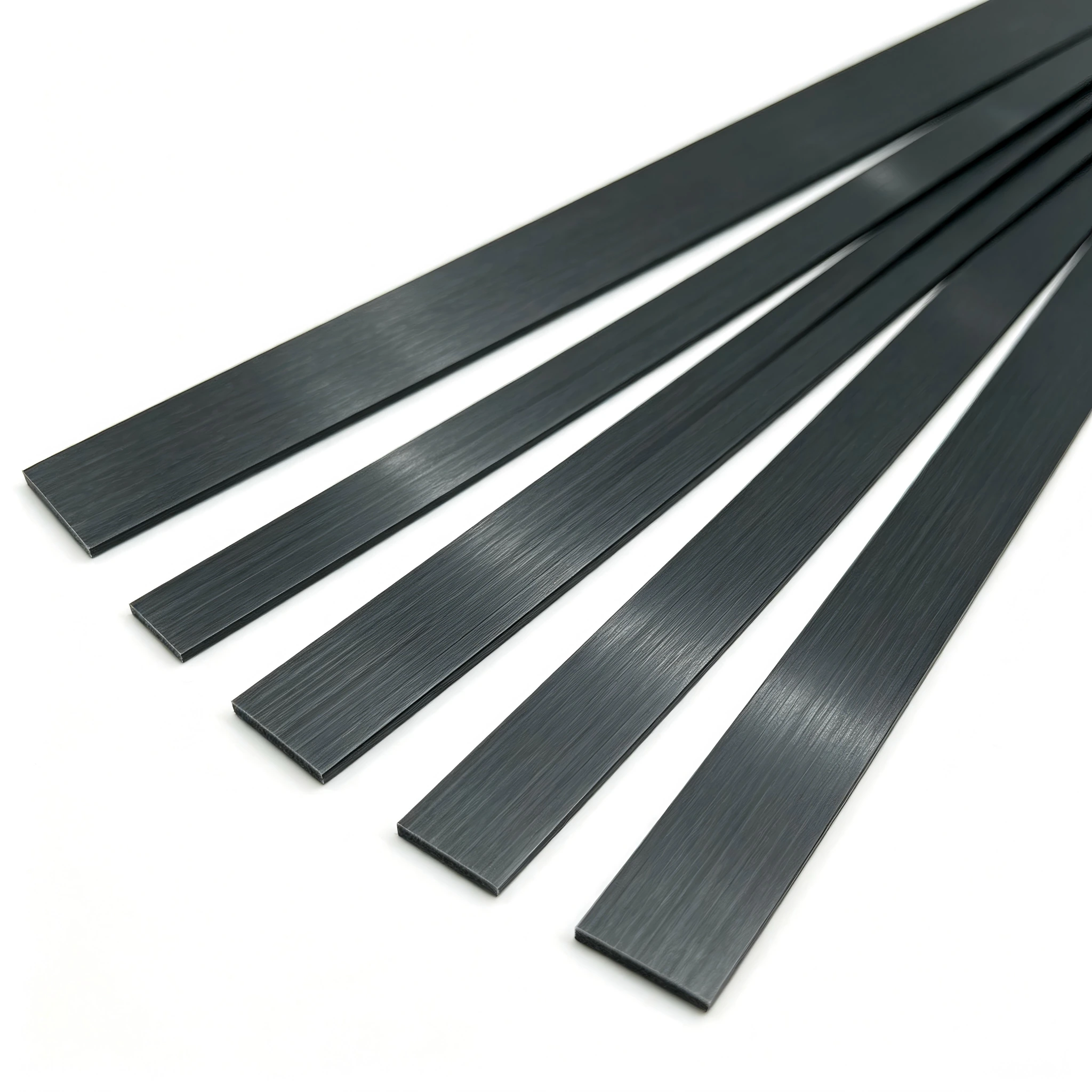
Which standard profiles come off the line?
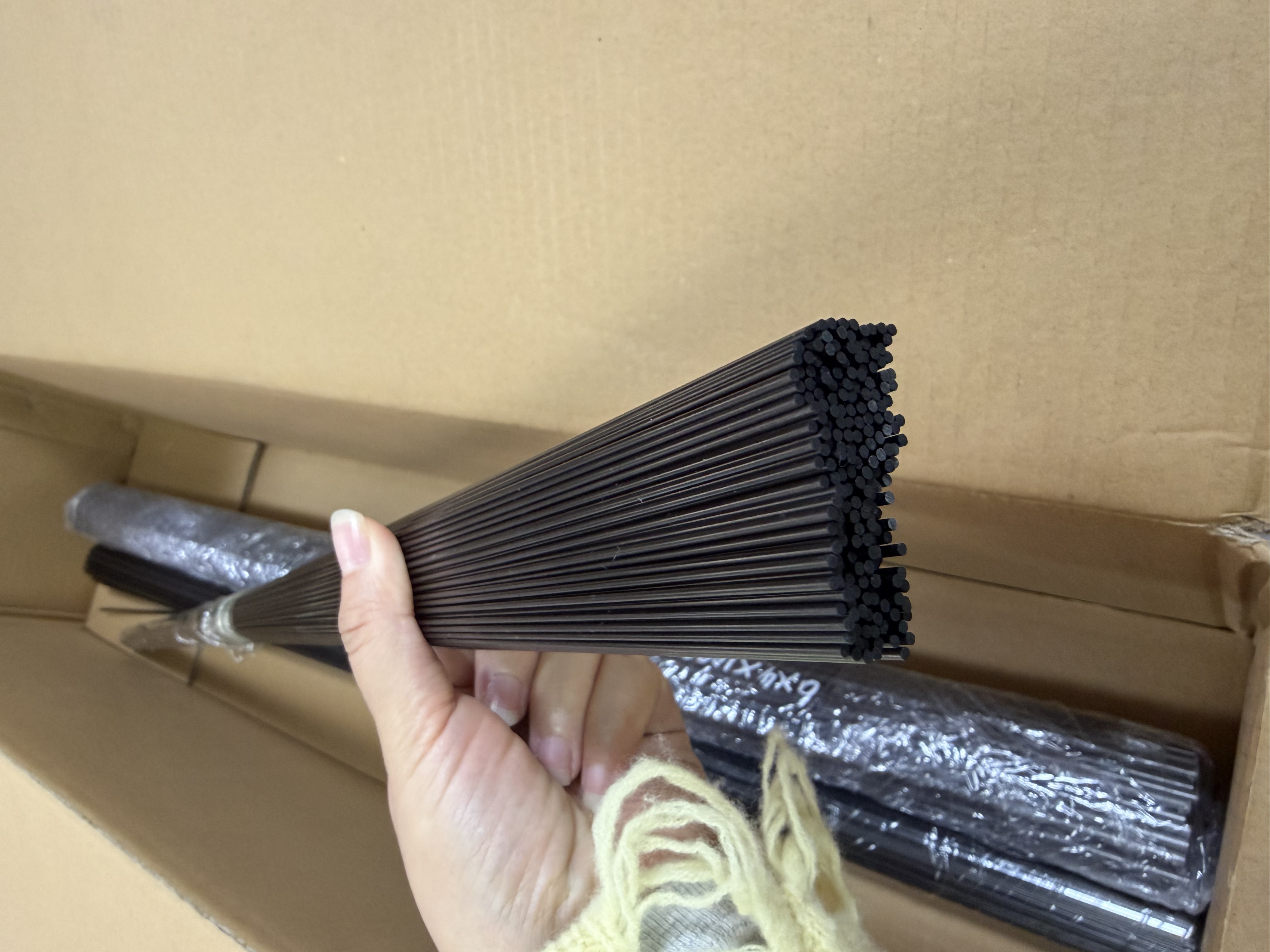
Standard sizes in the catalogue
Rods run from 0.5 to 5 mm diameter[3], square tubes from 1.4 × 1.4 to 10 × 10 mm with a round or square bore[4], and round tubes from 6/4 to 20/18 mm[5]. Rods and square tubes come in 1000 mm lengths, round tubes in 500 or 1000 mm. Strips are listed by width and thickness on the strip page; full sizes are in pultruded rod and strip sizes.
Is the resin tested?
Yes. The epoxy resin used for our pultruded tubes was tested against the EU RoHS directive 2011/65/EU and amendment (EU) 2015/863, covering lead, cadmium, mercury, hexavalent chromium, PBBs, PBDEs and four phthalates, with a pass result[6].
What to send for pultruded profiles
Profile type and size (diameter, or width × thickness, or outside × bore), length, tolerance if critical, surface (standard or sanded) and quantity. Use the quote form.
Sources
- Pultruded carbon fiber rods: solid bars made by continuous pultrusion, with high strength and stiffness along their length and consistent dimensions
- Zbcarbon factories: Dongguan makes tubes, sheets, pultruded profiles and finished parts
- Pultruded carbon fiber rod: CFR001 0.5 mm to CFR014 5.0 mm, 1000 mm
- Pultruded carbon fiber square tube: 17 sizes, 1.4 × 1.4 × 0.8 to 10 × 10 × 8 mm, round or square inside, 1000 mm
- Pultruded carbon fiber round tube: 6/4 to 20/18 mm, 500 or 1000 mm
- Test report A2250269984101003Ea, epoxy resin YPE-011 for pultruded carbon fiber tubes: EU RoHS 2011/65/EU and (EU) 2015/863, PASS, 27 April 2025 (copy on request)