Fiberglass or mineral wool acoustic ceiling tiles: which absorbs more sound and handles fire and humidity better?
If sound absorption and humidity are the priority, choose fiberglass panels: Zbcarbon’s fiberglass acoustic panel has an NRC of 0.9[1], against 0.55 to 0.7 for coated mineral wool board[2]. The fiberglass panel is rated A grade for fire[3] and is listed at 99% relative humidity[4]. Mineral wool board is rated B1[5] and RH70 to RH95[6], so it suits dry offices and corridors where a mid-range NRC is enough.
How do the three panel types compare?
| Fiberglass acoustic panel | Coated mineral wool board | Calcium silicate + glass wool panel | |
|---|---|---|---|
| Material | Dry synthetic high-density fiberglass[7] | Mineral wool with a sound-permeable film[8] | Perforated calcium silicate board backed with fiberglass wool[9] |
| NRC | 0.9[1] | 0.55–0.7[2] | not listed |
| Fire class | A grade[3] | B1[5] | A grade[10] |
| Humidity | RH 99 (40 °C)[4] | RH70 to RH95[6] | moisture-proof and waterproof[11] |
| Sizes (mm) | 600×600, 600×1200, 300×1200; 15 or 20 thick[12] | 600×600, 600×1200, 300×1200; 10–20 thick[13] | 600×600, 600×1200; 15, 16, 18, 20, 30 or 50 thick[14] |
What does an NRC of 0.9 versus 0.55 to 0.7 mean in a room?
NRC is the average share of sound a surface absorbs across the speech frequencies, from 0 (reflects everything) to 1 (absorbs everything). A ceiling at 0.9 absorbs most of the speech that reaches it, which keeps open offices, classrooms and wards quieter and makes speech easier to follow. At 0.55 to 0.7, a ceiling still helps, but hard rooms may need extra wall panels.
Noise reduction coefficient (NRC)
1.0 would absorb all sound reaching the ceiling.
What do “A grade” and “B1” mean?
These are the Chinese building-material fire classes. A grade is non-combustible; B1 is flame-retardant but combustible. Many hospital, school and escape-route specifications ask for A grade. Check what your local code and project specification require, and ask for the test report with the class.
Which panel for which room?
- Hospitals, labs, kitchens, pools and other damp rooms: fiberglass panels, for the 99% RH rating[4] and A grade fire class[3]. They are also formaldehyde-free[15].
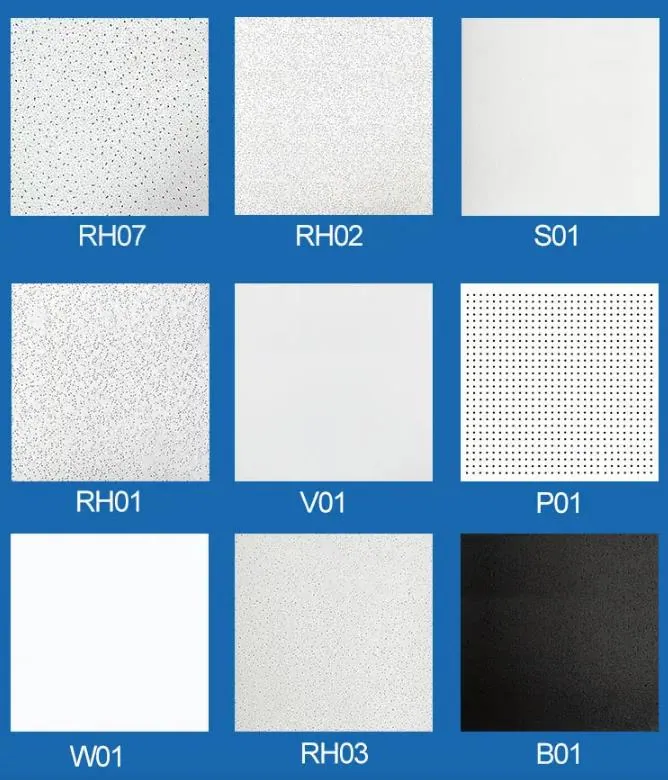
- Offices, libraries and corridors with normal humidity: coated mineral wool board, which comes with square, tegular, SLT, beveled tegular, concealed and shiplap edges[16].
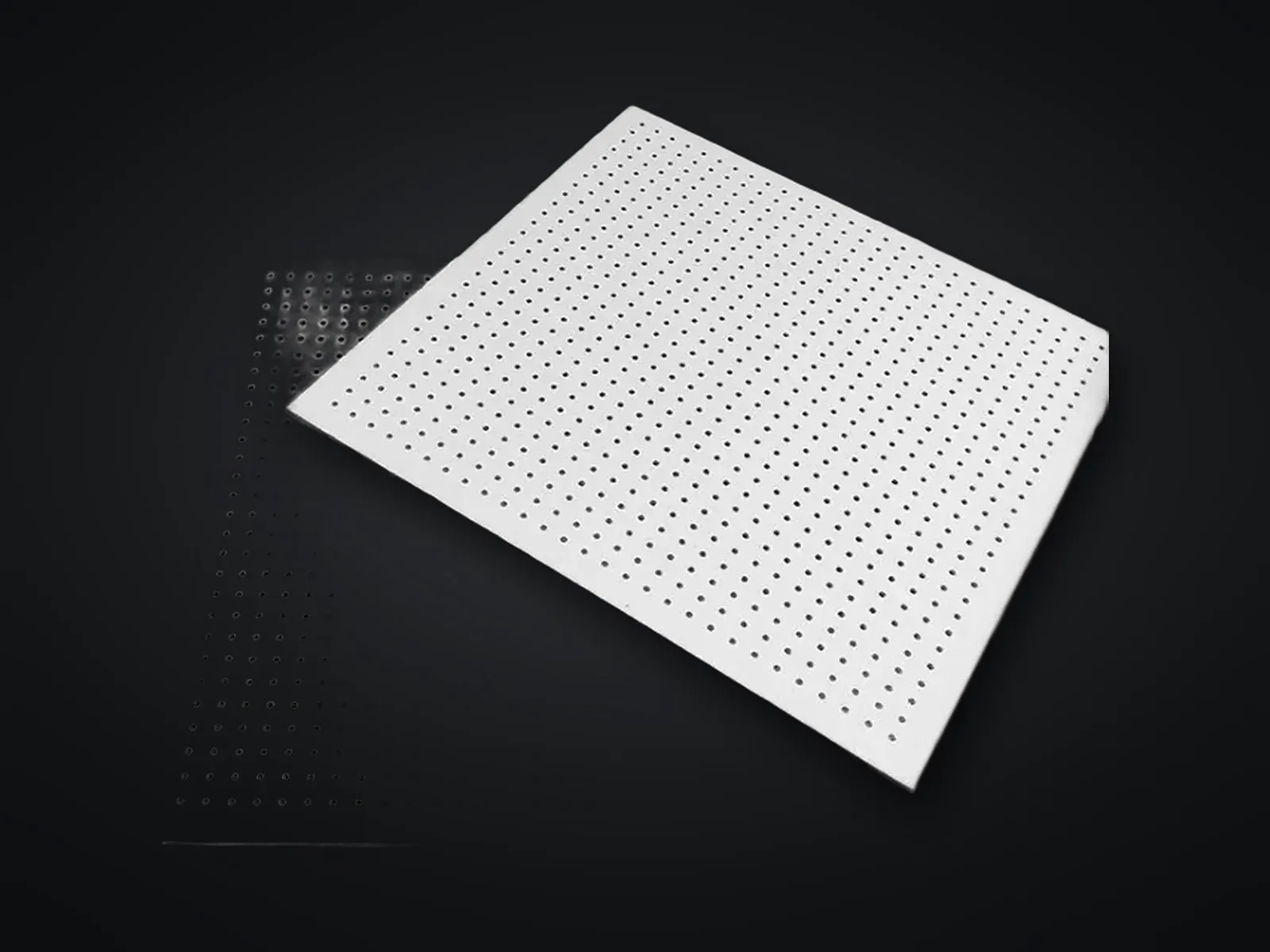
- Plant rooms and areas that also need impact resistance or thicker insulation: the calcium silicate and glass wool panel, which comes up to 50 mm thick[14] and does not deform easily[11].
Quote checklist
- Panel type and size, thickness and edge detail.
- NRC and fire class, with the test reports.
- Humidity rating for the room.
- Colour (white is standard; other colours to order)[17].
- Quantity in m² and the delivery schedule.
Send the room list through the quote form, or compare the fiberglass acoustic panel and the coated mineral wool board.
Sources
- NRC: 0.9
- NRC: 0.55–0.7
- Fireproof: A grade
- RH (Relative Humidity): 99 (40°)
- Fireproof: B1
- Moisture-proof coefficient: RH70 to RH95
- Material: Dry synthetic high density fiberglass
- A layer of sound-permeable film on ordinary mineral wool board
- Material: calcium silicate perforated acoustic panel + fiberglass wool
- Fireproof: A grade
- Performance: not easy to deform, compact structure, moisture-proof and waterproof
- Size: 600×600×15/20, 600×1200×15/20, 300×1200×15/20 mm (customizable)
- Size: 600×600, 600×1200, 300×1200 mm; thickness 10–20 mm
- Size: 600×600 and 600×1200 mm, 15/16/18/20/30/50 mm thick (customizable)
- Formaldehyde: Formaldehyde-free
- Corner: square, tegular, SLT, beveled tegular, concealed, shiplap edge
- Color: White, other colors can be customized