Which chopped carbon fiber should I use for conductive, ESD or reinforced plastics?
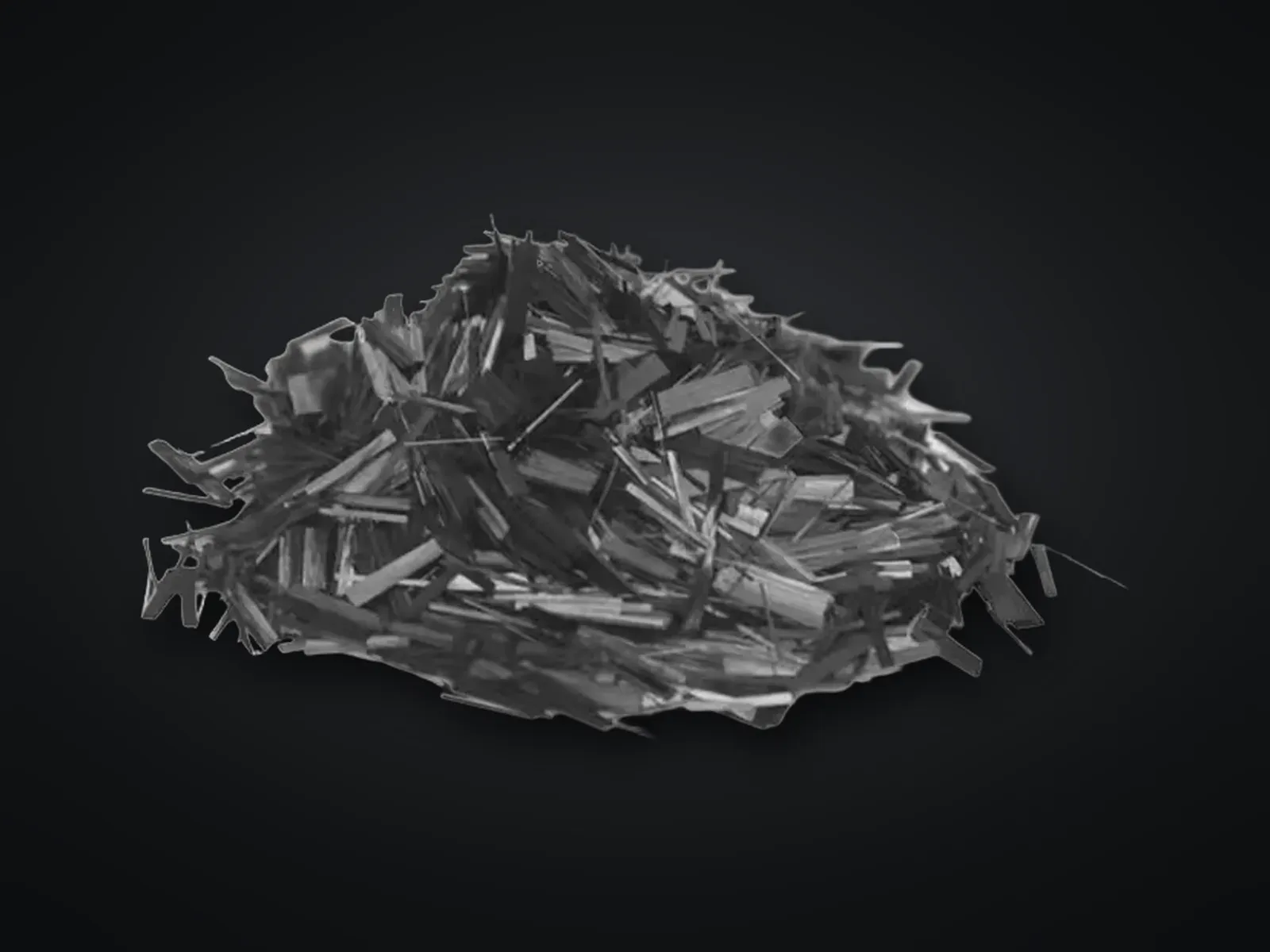
Choose by three things: the sizing must match your polymer, the length must suit your process, and the bulk density must suit your feeder. Our chopped carbon fiber is PAN-based, 7 µm in diameter, at least 95% carbon, and comes in 3, 6 and 12 mm lengths, or custom lengths from 1 to 50 mm[1].
What is in the specification?
| Item | Value |
|---|---|
| Raw material | PAN-based carbon fiber |
| Standard lengths | 3 mm, 6 mm, 12 mm |
| Custom lengths | 1–50 mm |
| Filament diameter | 7 µm |
| Carbon content | ≥ 95% |
| Density | 1.80 g/cm³ |
| Tensile strength | ≥ 3,500 MPa |
| Sizing agent | epoxy (EP), polyurethane (PU) or polyamide (PA) |
| Sizing content | 2.5–6.0% |
| Bulk density | 390–480 g/L |
All values from our catalogue[1].
Which sizing for which polymer?
The sizing is the coating that helps the fiber bond to the matrix and keeps strands together until they disperse. Match it to the matrix:
| Your matrix | Sizing to ask for |
|---|---|
| Epoxy, vinyl ester and other thermosets | EP (epoxy) |
| Polyurethane systems, some elastomers | PU (polyurethane) |
| PA6, PA66 and other nylons | PA (polyamide) |
| Other thermoplastics (PP, PC, PEEK, ABS) | send the polymer grade; we confirm the closest match |
Higher sizing content (toward 6%) keeps strands bundled for easier feeding. Lower content (toward 2.5%) usually disperses faster.
Which length for which process?
Standard lengths
- Short (3 mm) feeds and disperses easily in extruders and gives a good surface on molded parts.
- Longer (6–12 mm) gives more reinforcement per fiber, used in bulk molding compounds, felts and wet-laid mats.
- Concrete and mortar: the product page lists better crack resistance, frost resistance, toughness and durability of concrete as uses[2].
Why carbon fiber for ESD and EMI?
Carbon fiber conducts electricity. In a plastic, enough fibers touching each other form a conductive network, which bleeds off static charge (ESD) or blocks electromagnetic interference (EMI)[1]. Longer fibers form that network at a lower loading, but are harder to disperse. The right loading depends on your polymer, process and target resistance, so trial two lengths side by side.
What to send for a trial order
- Polymer or resin type and grade.
- Process: twin-screw compounding, injection molding, BMC, felt or concrete.
- Length and sizing, or your target property (strength, surface resistance, shielding).
- Trial quantity in kilograms and expected monthly volume.
Send it through the quote form or see the chopped carbon fiber page. For continuous tow, see which tow and grade to choose.
Sources
- Carbon fiber chopped strand: PAN-based, 3/6/12 mm, custom 1–50 mm, 7 µm, ≥95% carbon, 1.80 g/cm³, ≥3,500 MPa, EP/PU/PA sizing 2.5–6.0%, bulk density 390–480 g/L; for plastic modification, injection molding, ESD, EMI shielding and resin reinforcement
- Chopped carbon fiber in concrete: anti-seepage, frost resistance, toughness and durability