How thick should a carbon fiber sheet be? Thickness, stiffness and weight explained
Pick the thickness from the stiffness you need, because bending stiffness grows with the cube of thickness while weight grows only in proportion. A 2 mm carbon sheet is 8 times as stiff in bending as a 1 mm sheet and twice as heavy. To replace an aluminum plate with the same bending stiffness, a woven carbon sheet needs about 8% more thickness and weighs about 36% less[1][2].
Thickness, stiffness and weight
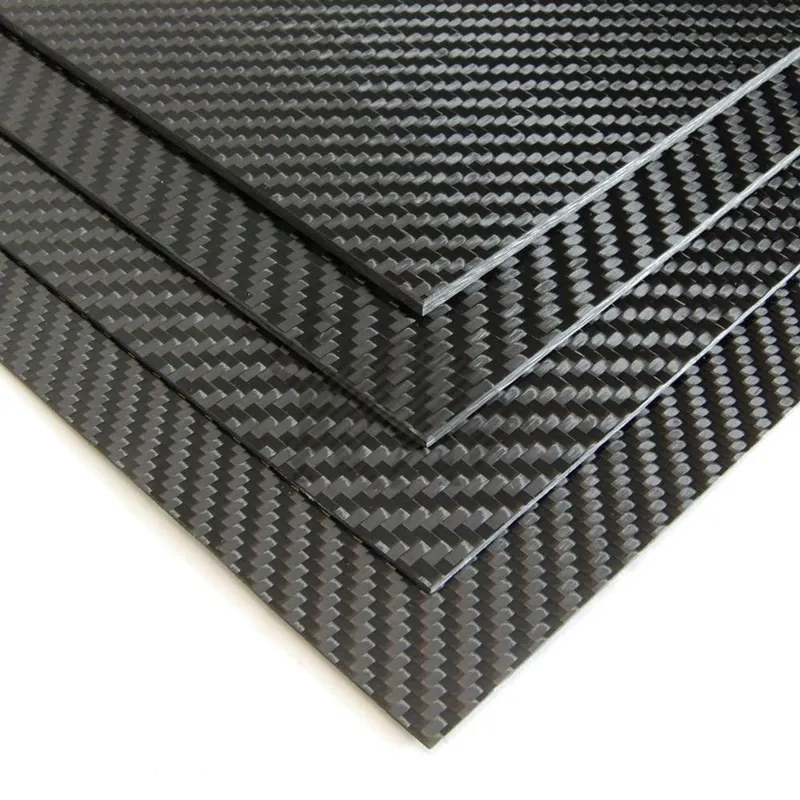
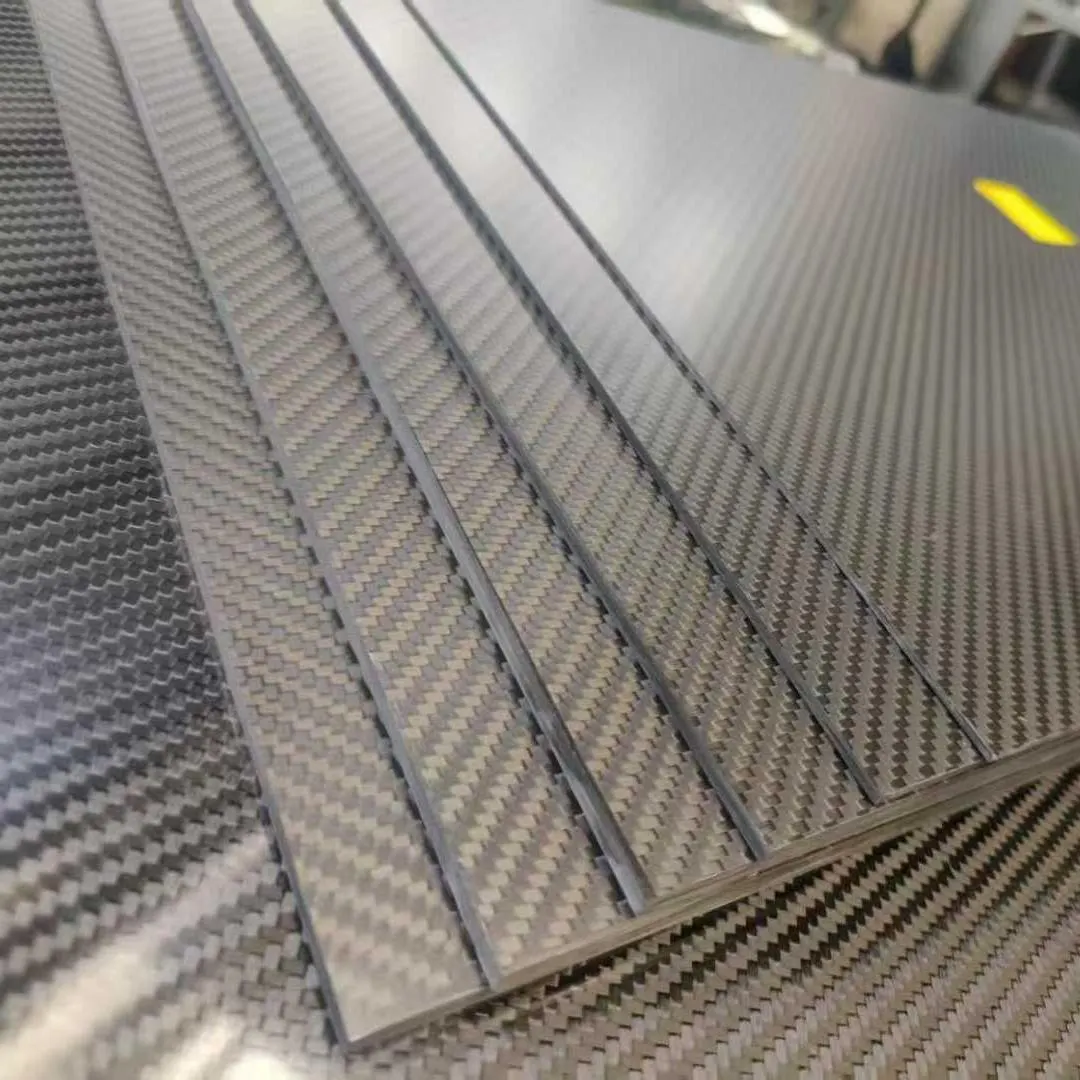
Standard 3K T300 sheets come in 1 to 5 mm[3]. Relative to a 1 mm sheet of the same size:
| Thickness | Relative weight | Relative bending stiffness | Weight per m² (at 1.6 g/cm³) |
|---|---|---|---|
| 1 mm | 1 | 1 | 1.6 kg |
| 2 mm | 2 | 8 | 3.2 kg |
| 3 mm | 3 | 27 | 4.8 kg |
| 4 mm | 4 | 64 | 6.4 kg |
| 5 mm | 5 | 125 | 8.0 kg |
Relative bending stiffness (1 mm = 1)
Replacing an aluminum plate
For the same bending stiffness, thickness scales with the cube root of the modulus ratio. With aluminum at 68.9 GPa and 2.7 g/cm³[1] and a woven T300 laminate at 55 GPa[2] and about 1.6 g/cm³[1]:
| Aluminum plate | Woven carbon sheet, same stiffness | Weight saving |
|---|---|---|
| 2.0 mm | 2.16 mm (order 2.5 mm, custom, or 3 mm, standard) | about 36% |
| 3.0 mm | 3.23 mm (order 3.5 mm, custom, or 4 mm, standard) | about 36% |
| 5.0 mm | 5.39 mm (custom thickness) | about 36% |
Thickness ratio = (68.9 ÷ 55)^(1/3) = 1.078. Weight ratio = 1.078 × 1.6 ÷ 2.7 = 0.64.
Sheets with unidirectional layers inside can be stiffer than woven sheets in the main direction, so a thinner sheet may be enough. High-modulus fibers (M40 and above) also allow thinner sheets[4]. T700 is a high-strength grade, not a high-modulus one: its unidirectional laminate is only about 4% stiffer than T300 (125 vs 120 GPa).
Typical thicknesses by use
| Use | Common thickness |
|---|---|
| Covers, trim, light brackets | 0.5–1 mm |
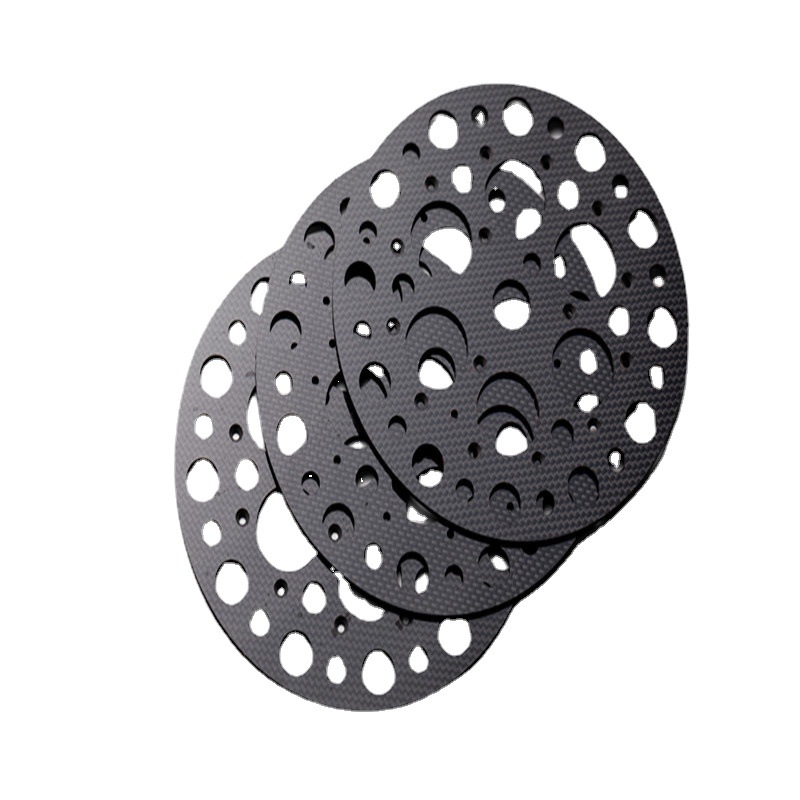
| Small drone frames, camera plates | 1.5–3 mm |
| Larger drone arms and frames, robot plates | 3–5 mm |
| Machined fixtures and blocks | custom, up to 150 mm |
Custom sheets can be made from 0.2 to 150 mm thick and up to 9000 × 3000 mm[4].
What to send
Your current plate material and thickness, the size, and the load or deflection limit. We will suggest a carbon thickness and layup. Send it through the quote form, or see ordering CNC carbon sheet parts for drawings and finishes.
Sources
- DragonPlate, “Carbon Fiber vs Aluminum”: aluminum 68.9 GPa and 2.7 g/cm³; carbon fiber composite about 1.6 g/cm³
- Technical data sheet, woven T300 prepreg T200R4024T: laminate tensile modulus 55 GPa (available on request)
- Standard carbon fiber sheets: 3K T300, 1, 2, 3, 4 and 5 mm
- Custom carbon fiber sheet: 0.2–150 mm thick, up to 9000 × 3000 mm, T300 to M60