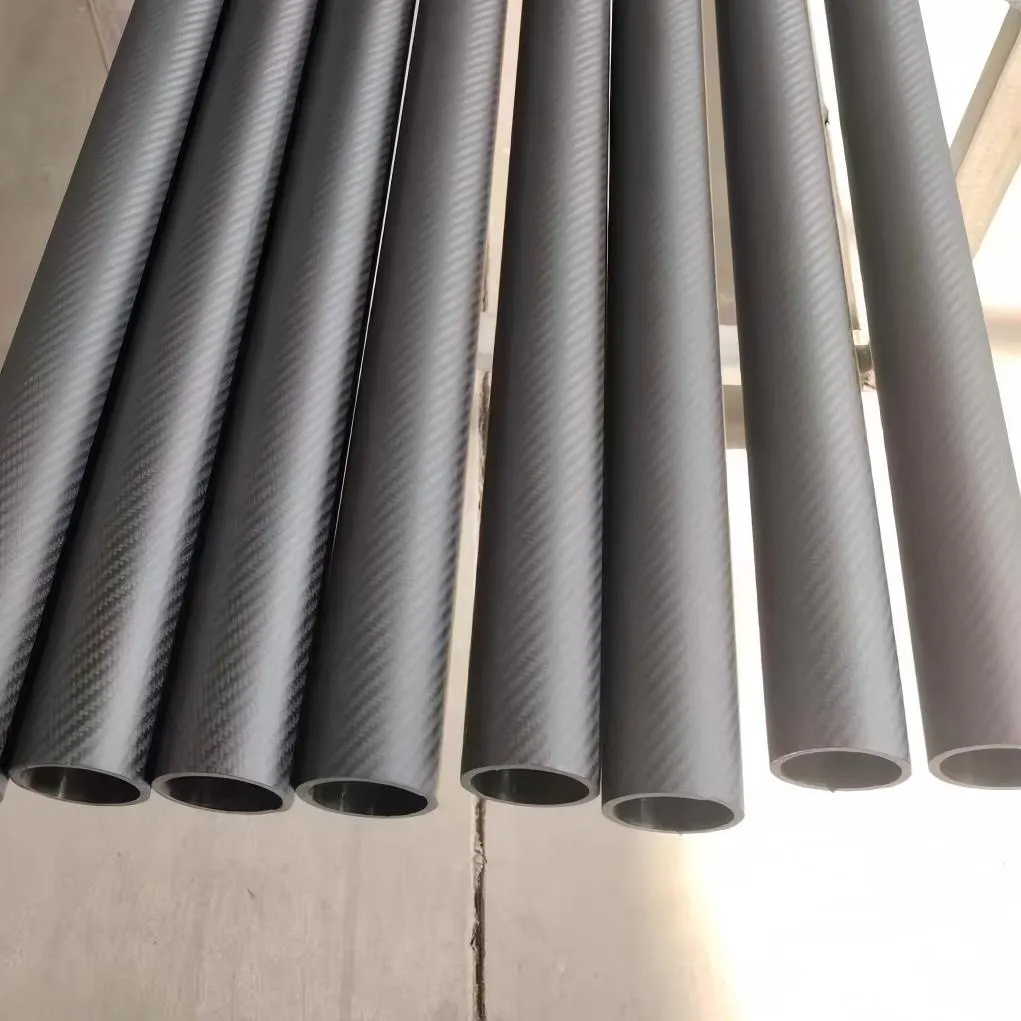
Carbon fiber selection guide
Start from your part: pick the form, then the process, then the weave and finish. Size ranges are from our standard catalogue; other sizes are made to order.
1. Choose the form
| Form | Typical parts | Choose it when | Standard range | Sizes |
|---|---|---|---|---|
| Carbon fiber sheet | Drone frames, brackets, panels, covers, jigs | The part is flat, or can be CNC-cut from a flat plate. | 1–5 mm thick | Size table |
| Roll-wrapped tube | Booms, arms, poles, handles, frames | You need a woven (plain or twill) cosmetic surface, custom color or length, or a tube that takes bending and torsion. | OD 6–20 mm | Size table |
| Pultruded round tube | Spars, struts, kite and RC parts, long straight members | Load is mainly along the tube axis and you want consistent dimensions at a lower cost per meter. | OD 6–20 mm | Size table |
| Pultruded square tube | Frames, rails, robot arms, structures with flat faces | You need flat mounting faces or a square profile that resists rotation. | See catalogue | Size table |
| Pultruded rod | Stiffeners, pins, antenna and kite spars | A solid section is needed, or the diameter is too small for a hollow tube. | Ø 0.5–5 mm | Size table |
| Pultruded strip | Wing spars, bow limbs, reinforcement strips, springs | You need a thin flat bar with high stiffness along its length. | See catalogue | Size table |
| Woven fabric | Hand lay-up, vacuum infusion, wet lay-up repairs | You make your own parts and need dry cloth to combine with your resin. | 100–480 g/m² | Size table |
| Prepreg | Autoclave or press-cured parts, sporting goods, high-quality surfaces | You need controlled resin content and a repeatable laminate, and you can cure with heat. | 200–400 g/m² fiber | Size table |
| Roving (tow) | Weaving, pultrusion, filament winding, braiding | You run your own fiber process and need continuous tow. | See catalogue | Size table |
| Chopped strand | Molding compounds, thermoplastic compounding, conductive fillers | You need short fiber to reinforce a molded or compounded material. | See catalogue | Size table |
2. Understand the process
The same outside size can be made in different ways. The process sets how the fibers run, and so how the part carries load. More detail: roll-wrapped vs pultruded tubes.
Roll wrapping
Prepreg sheets are wrapped around a steel mandrel, then cured and the mandrel removed. Good for: Woven cosmetic faces, tailored fiber angles, good bending and torsion stiffness. Limits: Length is limited by the mandrel; costs more per meter than pultrusion.
Pultrusion
Fiber is pulled continuously through resin and a heated die that sets the profile. Good for: Consistent cross-section, long lengths, cost-efficient for straight profiles. Limits: Fibers run mostly along the length, so hoop and torsion strength are lower.
Filament winding
Resin-wetted tow is wound onto a rotating mandrel at set angles. Good for: Pressure vessels and large-diameter tubes where hoop strength matters. Limits: Surface is less cosmetic. Not part of our catalogue range; listed for comparison.
Press / compression molding
Prepreg or molding compound is cured in a heated mold under pressure. Good for: Flat sheets and repeatable 3D parts with good surface on both sides. Limits: Needs a mold, so best for repeat volumes.
3. Pick the weave and finish
Tow size changes the look and the price: see 3K, 12K or 24K and prepreg or dry fabric.
Resin compatibility: our catalogue lists carbon fiber fabric as compatible with epoxy, polyester and vinyl ester resins, and fiberglass plain weave fabric with unsaturated polyester, vinyl ester, epoxy and phenolic resins. Name your resin system in the RFQ.
Plain weave
Over-under weave with a tight, checkerboard look. Holds its shape when cut and handled.
Twill weave (2×2)
Diagonal pattern that drapes better over curves; the classic cosmetic carbon look.
Unidirectional (UD)
All fibers in one direction for maximum stiffness along that axis; often used inside a woven face.
Glossy finish
Clear high-gloss surface that shows the weave; chosen for visible consumer parts.
Matte finish
Low-glare satin surface that hides fingerprints and small scratches; common for drone and industrial parts.
4. What to put in your RFQ
With these details we can quote in one reply instead of several rounds of questions.
- Product form (sheet, tube, rod, fabric…) and the application
- Dimensions with tolerances: thickness or OD/ID, width, length; a drawing (PDF, DWG or STEP) if it is a machined part
- Weave and finish: plain, twill or UD; glossy or matte; color if any
- For tubes: round, square or rectangular; OD and ID or wall thickness; length; roll-wrapped or pultruded
- For fabric and prepreg: tow (1K/3K/12K), weight in g/m², width, resin system
- Quantity per order and per year, and whether you need samples first
- Delivery country and the documents your inspection needs